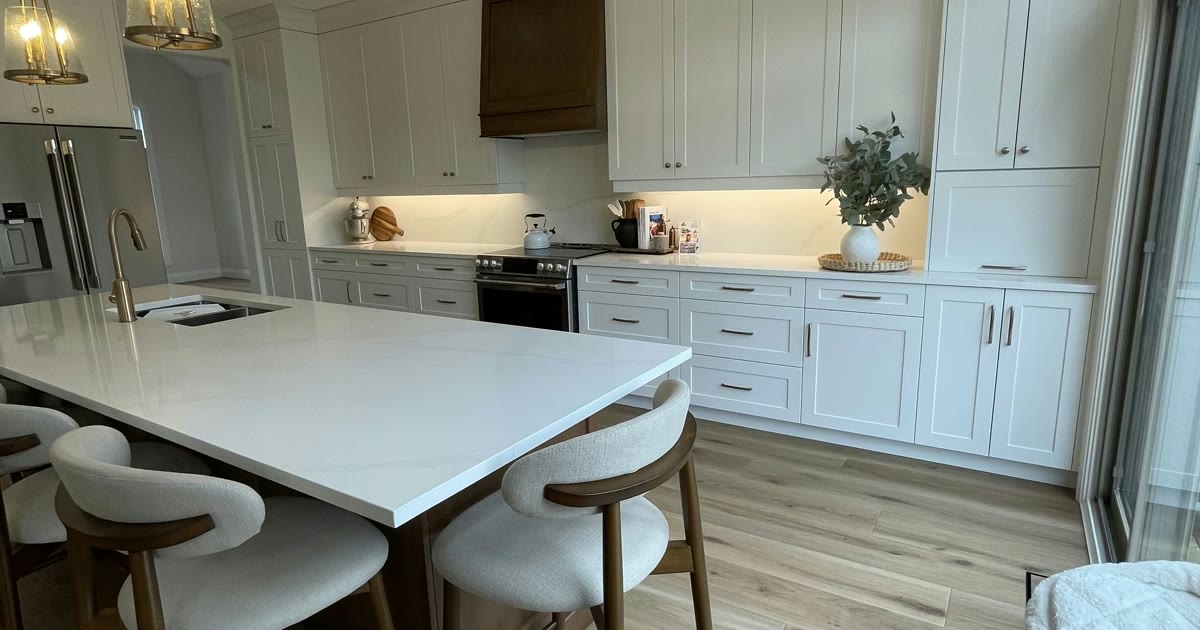
We hear this question from homeowners planning their first major renovation all the time: "We have a dated kitchen and an unfinished basement — which one should we do first?" Sometimes the budget covers one or the other, but not both. Sometimes they're wondering whether to split the money. And sometimes they just want someone to tell them what the smarter investment is.
The truthful answer isn't universal. But after doing renovations across Brantford and Brant County for years, we have a framework for thinking about it — and some real numbers to share.
What each renovation actually costs in Brantford
Before comparing returns, it helps to be clear on what you're spending. In the Brantford market in 2026:
| Project type | Typical range |
|---|---|
| Mid-range kitchen renovation (new layout, semi-custom cabinets, stone counters) | $55,000–$85,000 |
| High-end kitchen renovation (custom cabinets, full structural work) | $90,000–$150,000+ |
| Basic basement finishing (rec room, no bathroom) | $35,000–$55,000 |
| Full basement finishing (bedroom, bathroom, egress window) | $65,000–$95,000 |
| Legal secondary suite (separate entrance, full kitchen) | $90,000–$130,000 |
The ranges are wide because scope varies enormously. A basement finishing project that adds a bedroom and bathroom costs dramatically more than one that's just drywall and pot lights in a rec room. Same for kitchens — a cosmetic refresh with new fronts and counters is a different project than a full gut with structural work.
The kitchen case: high visibility, high return
Kitchens consistently return more of their investment at resale than almost any other room in the house. Industry cost-value studies commonly cited in Canadian real estate commentary put mid-range kitchen renovations in the range of 75–100% of cost recouped at resale — figures like this vary by source, region, and year, and Brantford-specific data isn't published separately, so treat this as a directional benchmark rather than a guarantee for any specific home. Part of the effect is visibility: buyers see the kitchen immediately, and a dated kitchen can weigh on perceived value more than almost anything else.
The other factor is daily use. A kitchen renovation improves your life every single day you live in the house. If you're cooking in a cramped, awkward layout with 1990s cabinets and laminate counters, the quality-of-life argument for doing the kitchen first is strong — regardless of the numbers.
Where kitchen renovations can go wrong from a value standpoint is over-renovation relative to the neighbourhood. A $150,000 kitchen in a $600,000 Brantford home will not return the same percentage as the same renovation in a $900,000 home. The ceiling on resale value in a given neighbourhood limits how much any single renovation can return.
The basement case: square footage and rental potential
A finished basement adds usable square footage to the home — and in Brantford's housing market, square footage matters. A properly finished basement with a bedroom, bathroom, and egress windows can add 500–700 sq ft of liveable space to a home, which meaningfully shifts the home's market position.
The resale return on a finished basement typically runs lower than a kitchen on a straight cost-recouped-at-resale basis — commonly cited benchmarks put it in the 65–80% range for a standard rec-room-plus-bedroom finish, with the same caveat that these figures are directional, not Brantford-specific. But the calculation changes if the basement produces income rather than just square footage.
Based on current rental listings we've reviewed in the Brantford area as of mid-2026, a legal secondary suite (with a separate entrance, full kitchen, and proper fire separation) has rented in the approximate range of $1,500–$2,200/month. Using $1,800/month as an illustrative midpoint: that's $21,600 per year in gross rental income. On a $110,000 project cost, that's roughly a 20% gross annual return — before expenses, financing costs, vacancy, and management time, and different math from a kitchen's resale-return percentage since it isn't a net figure. Run your own numbers with a mortgage broker or accountant before relying on rental income projections.
If you're planning to stay in the home for 5+ years and the basement could be a legal suite, the basement often wins on pure financial return. If you're planning to sell within 2–3 years, the kitchen is almost always the better investment.
The question within the question: what's your home missing?
Value is relative to starting point. If your kitchen is genuinely dysfunctional — bad layout, no storage, falling-apart cabinets — fixing it will have outsized impact. Buyers (and you) will notice a bad kitchen immediately. A dated but functional kitchen in an otherwise nice home has less drag on perceived value.
On the basement side: if your home has three bedrooms on the main floor and an unfinished basement, finishing it adds a bedroom count that changes which buyers consider your home. A home that goes from "3 bed, 1.5 bath" to "4 bed, 2.5 bath" is a meaningfully different listing in Brantford's market.
We always ask homeowners who bring this question to us: what would bother a buyer more — the kitchen or the unfinished basement? And separately: what bothers you more, right now, living here? Those two answers often point in the same direction.
When to do both (and how)
If your timeline and budget allow for both eventually, sequencing matters. We generally recommend doing the basement first if a secondary suite is the goal — rental income can offset the cost of a future kitchen renovation. If resale is coming in the next few years and the kitchen is the bigger problem, do the kitchen first and leave the basement for the next owners.
Some homeowners tackle both at once to avoid living through two separate renovation disruptions. There's a real argument for that approach: trades are already mobilized, permits can sometimes be combined, and the disruption is compressed into one period instead of two. It's not always possible financially, but when it is, it often makes practical sense.
Decision matrix: which one fits your situation?
| If this is your priority… | Kitchen | Basement |
|---|---|---|
| Selling within 2–3 years | Usually the stronger resale play | Lower resale-return percentage unless it's an income suite |
| Staying 5+ years and want rental income | No income potential | Legal secondary suite can generate ongoing rent |
| Daily quality of life right now | High — used multiple times a day | High if adding a needed bedroom/office, lower if just "bonus space" |
| Adding bedroom count for buyer search filters | No effect | Can shift your home into a different listing bracket |
| Budget is tight and disruption matters | Smaller footprint, shorter disruption | Larger scope, longer timeline, but often lower cost per sq ft added |
Talk it through before you decide
The right answer depends on your home's specific condition, your neighbourhood, your timeline, and whether a rental suite makes sense for your situation. We're happy to walk through all of it with you. Our estimates are free and there's no obligation — sometimes a 45-minute site visit clarifies the decision entirely.
If you're weighing a kitchen or basement renovation in Brantford or Brant County, get in touch and we'll come take a look.
For more on this topic, see our kitchen and basement renovation services.
See this in a real HandKind project

Also worth reading:
Sources and references
- Rental figures based on active listings we reviewed in the Brantford market, mid-2026. Resale-return percentages are directional industry benchmarks, not Brantford-specific data — actual results vary by property and market conditions.